One of my priorities is safer, stronger neighbourhoods.
Going door to door in Ward 4, residents often raise concerns about speeding on side streets. Parents worry about kids walking or biking. Seniors worry about crossing the road. And many residents are frustrated by drivers speeding through quiet neighbourhood streets late at night.
They’re right to raise it. Everyone deserves to feel safe on their own street.
Start with the facts and listen to residents
If elected, I’ll work with residents, Town staff, and Durham Regional Police to identify the streets where speeding is a real, repeated problem.
That means looking at speed data, traffic volumes, near misses, school routes, and what residents are seeing day to day. I’ll also make sure Ward 4 residents can see what was found and what options are being considered.
Use the right tools for each street
There isn’t one answer that works everywhere.
Traditional tools can help when used in the right place. That can include better signs, pavement markings, speed-feedback signs, raised crossings, traffic circles, flexible posts, and targeted changes at intersections.
Stop signs can improve safety where there’s a real intersection problem. But they aren’t meant to be used only to slow drivers down. The same goes for speed humps. They can work in some places, but they can also affect emergency response and push traffic onto nearby streets. We need to look at the full picture before choosing a solution.
Learn from what’s working nearby
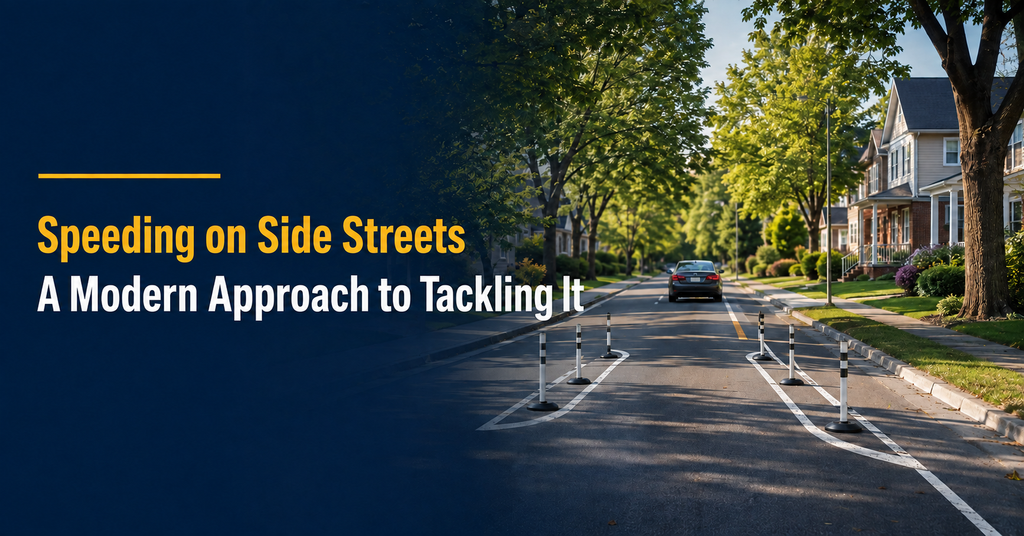
Clarington has used painted lane-narrowing designs and flexible, collapsible posts to make drivers slow down and pay attention. The posts create a visual narrowing effect without blocking emergency vehicles.
Whitby should look at similar low-cost ideas for streets where they make sense. A small pilot can show whether a tool works before taxpayers are asked to fund it across town.
Look at newer ideas too
We should also be open to newer traffic-calming tools.
In Sweden, a system called Actibump uses a speed-responsive road device. Drivers travelling at the speed limit pass over a flat road surface. If a driver is speeding, part of the road surface lowers slightly, creating a quick jolt and a clear reminder to slow down.
Actibump says its system can reduce speeding by up to 99%. Results will vary by street, traffic volume, speed limit, and how the device is used. In one published Swedish example, the share of drivers speeding dropped from 75% to 21%. In a Perth, Australia pilot, speeding fell by an average of 78.7% after 10 months.
Those results are promising. But I won’t pretend a device used overseas can simply be dropped into Whitby tomorrow.
Any new technology would need to meet Ontario rules, work through our winters, be safe for emergency vehicles, and be worth the cost. I’d ask Town staff to review whether a small, carefully chosen pilot could work in a serious problem area, then share the results with residents before any larger investment.
Use technology carefully and respect privacy
I’d also ask Town staff and Durham Regional Police to review whether solar-powered, all-weather, cellular-connected safety cameras could help in a small number of problem locations.
These wouldn’t be used to issue speeding tickets. Ontario doesn’t allow municipal automated speed cameras to do that anymore.
The goal would be to help understand traffic patterns, support targeted enforcement where it’s needed, and act as a visible deterrent to drivers who may be speeding. Any pilot would need clear public signs, strict privacy rules, limited access to information, and a public report on the results. If a less intrusive tool works just as well, we should use it instead.
What I’ll push for as your Ward 4 Councillor
If elected, I’ll push for a clear process:
- Listen to residents and collect real traffic data
- Make the results public in plain English
- Use proven, practical traffic-calming tools first
- Test newer ideas through small, affordable pilots
- Work with DRPS on targeted enforcement where it’s needed
- Report back to residents on what worked and what didn’t
This isn’t about expensive gadgets or one-size-fits-all answers. It’s about taking residents seriously, using common sense, and making Ward 4 streets safer for kids, families, seniors, walkers, cyclists, and drivers.