
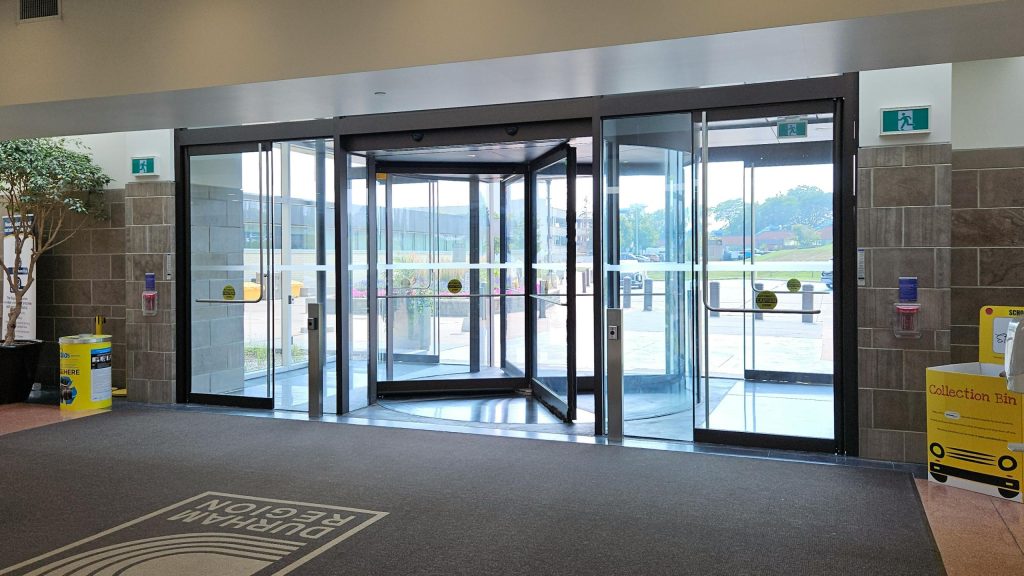
The cost is real. But it wasn’t just one door.
Many residents are upset after receiving a petition that points to a “$1 million revolving door at Durham Region Headquarters.”
I understand why. A million dollars for a door sounds outrageous. It should make us ask what was purchased, why it was needed, how the contractor was chosen, and whether residents received fair value.
The claim is based on a real project and a real number. But calling it a “$1 million revolving door” leaves out important facts.
My goal isn’t to defend Durham Region or attack the people behind the petition. I believe accountability and clear communication are two of a councillor’s most important duties. This is an example of how I’ll serve residents: share the full picture, explain what’s known and what’s still missing, give my honest view, and help residents make an informed decision for themselves.
The quick answer
The petition says: Durham Region spent $1 million on a revolving door.
The records show: Durham Region spent close to $1 million on a full front entrance project. It included an automatic revolving door, four accessible swing doors, security features, and related work.
My view: The petition’s wording is incomplete, but the cost is still high enough to deserve a clear review. The Region has explained how the contractor was chosen, but it hasn’t yet shown residents enough proof that the full project delivered good value.
What was included in the project?
This wasn’t a Town of Whitby project. It was completed by the Regional Municipality of Durham at its headquarters on Rossland Road.
According to Durham Region’s current project page, the work included:
- One automatic revolving door
- Four swing doors that meet Ontario accessibility rules
- Added security features
An earlier statement from the Region also referred to heating, cooling, and ventilation work connected to the new entrance system.
The old sliding-door system was almost 20 years old. The Region says it had access, safety, and energy concerns. Cold air entered during the winter, and hot air entered during the summer.
The Region estimates the new revolving-door system is at least eight times more energy efficient than the old sliding doors. That’s an estimate, though. I haven’t found a public report showing the actual energy savings in dollars or how many years it will take those savings to recover the cost.
How much did it cost?
The Region’s current public breakdown lists:
| Funding source | Amount |
|---|---|
| Federal and provincial funding | About $440,000 |
| Money moved from two other approved projects | $498,000 |
| Regional property-tax funding | $57,600 |
| Total | About $995,600 |
That means the petition’s $1 million figure is close to the full amount connected to the front entrance work.
However, it’s important to understand where that money came from.
It wouldn’t be fair to say Whitby and Durham property owners were charged a new $1 million tax for this project. Only $57,600 is listed as direct Regional property-tax funding.
But it also wouldn’t be fair to suggest that only $57,600 mattered. Government grants and money moved from other projects are still public money. The $498,000 could have been used for the two projects it was taken from.
The Region’s public project page doesn’t name those two projects or explain whether they were delayed, reduced, completed under budget, or no longer needed. Residents deserve that information.
How was the contractor chosen?
The project went through a public tender under contract T-1047-2023. It was posted in June 2023, and bids closed in July 2023. Three companies submitted bids.
The bids were:
| Company | Bid |
|---|---|
| Royalty General Construction Ltd. | $734,750.00 |
| Sals PMD Corp. | $788,600.00 |
| SBN Construction Corporation | $798,795.72 |
The contract was awarded to Royalty General Construction, which submitted the lowest bid.
Four changes were approved during construction at a total cost of $45,554.75. That brought the maximum approved construction contract to $780,304.75. The Region reported that the changes added 6.2% to the original construction bid.
This tells us the construction work was put out for competition and the lowest bid was selected. That’s important.
But a competitive bid doesn’t answer every question. It tells us the Region found the lowest qualified bid for the project it designed. It doesn’t prove that the original plan was the best or least costly way to fix the entrance.
Why have residents heard different numbers?
Part of the confusion comes from Durham Region’s own communication.
In July 2025, the Region said the project used:
- $403,000 in federal funding
- $249,000 moved from an existing maintenance project
- $249,000 in added financing
That statement also referred to two accessible swing doors.
The Region’s newer public page says the project used:
- About $440,000 in federal and provincial funding
- $498,000 moved from two approved projects
- $57,600 in property-tax funding
It also refers to four accessible swing doors.
There may be a fair accounting reason for these differences. The later figures may include updated costs or group the funding in a different way.
But residents shouldn’t need to solve a municipal math puzzle to understand how almost $1 million was spent.
Durham Region should publish one final report that clearly connects the original plan, construction contract, added work, other project costs, final invoices, and funding sources.
Was it wasteful spending?
My honest answer is that the public records don’t give me enough evidence to call the whole project proven waste.
There were valid reasons to replace the old entrance. The doors were nearly 20 years old. There were safety, access, comfort, and energy concerns. The construction work was publicly tendered, three companies bid, and the lowest bid was selected.
But I also don’t believe Durham Region has done enough to prove that the full project delivered good value.
I still want to know:
- Why was a revolving-door system the best option?
- What other entrance designs were considered?
- What made up the difference between the construction contract and the full project cost?
- Which two projects lost $498,000 in funding?
- What are the actual yearly energy savings?
- What will maintenance and repairs cost?
- How long will it take for the energy savings to recover the added cost?
Until those questions are answered, it’s too early to declare the project either a clear waste of money or a clear success.
What happened to the call for an audit?
In September 2025, Regional Councillor Chris Leahy brought forward a motion, seconded by Whitby Regional Councillor Steve Yamada, asking for an independent value-for-money audit of the wider Durham Region Headquarters renewal project.
A value-for-money audit looks beyond whether spending followed the rules. It asks whether public money was used in the most careful, efficient, and effective way.
Regional Council defeated the motion. Seven members supported the audit and 18 voted against it.
I believe supporting an independent review would have helped rebuild trust.
An audit doesn’t assume anyone did something wrong. It checks the facts, identifies lessons, and helps prevent the same concerns from happening again.
What I believe should happen next
This project shows why government needs to communicate before public concern turns into anger and distrust.
Here’s what I believe Durham Region should do:
Publish one final project report
The report should show the original budget, approved changes, final invoices, full project cost, funding sources, and the reason for each major decision.
Explain where the transferred money came from
Residents should be told which two projects provided the $498,000 and what happened to them.
Report the real energy savings
The Region should compare energy use before and after the work. Results should be published after one year and again after two years.
Require independent reviews when costs raise concern
Large projects that grow well beyond their first public estimate, or create serious public concern, should face an independent value-for-money review.
This is one reason I’ll fight for an independent Auditor General. Council and staff shouldn’t be expected to review their own decisions and then ask residents to simply trust the result.
My commitment to residents
I don’t support giving residents only the most shocking number while leaving out the rest of the story.
But I also don’t support using missing context as an excuse to avoid hard questions.
The full story is that Durham Region spent close to $1 million on an entrance project that included more than one revolving door. The project had real safety, access, and energy goals, and the construction work was competitively bid.
The full story is also that residents still don’t have a simple and complete explanation of the final cost, the money moved from other projects, or the real savings delivered.
Both things can be true.
As your local councillor, I’ll tell you what I know, what I don’t know, what I personally think, and what I’m doing to get answers. This was a Durham Region project, but that doesn’t mean a local councillor should stay silent. I’ll bring residents’ questions to our Regional representatives and share the answers clearly.
What do you think?
Now that you know more about what was included, does it change how you feel about the project?
Do you believe Durham Region has shown that residents received good value?
What other information would you like the Region to release?
I want to hear your thoughts, even if your view is different from mine.
Sources
The links below are official Durham Region records used to prepare this article:
- Durham Region: Let’s Talk About the Door
- Durham Region’s July 21, 2025 Statement
- Public Tender T-1047-2023
- Durham Region Project Update, Report 2025-W-28
- September 24, 2025 Regional Council Minutes
This article is based on public records available as of July 17, 2026. I’ll update it if new information becomes available.