One of my top priorities is better communication from Town Hall.
When Council makes a decision that could affect future infrastructure spending and taxpayers, residents deserve the full picture.
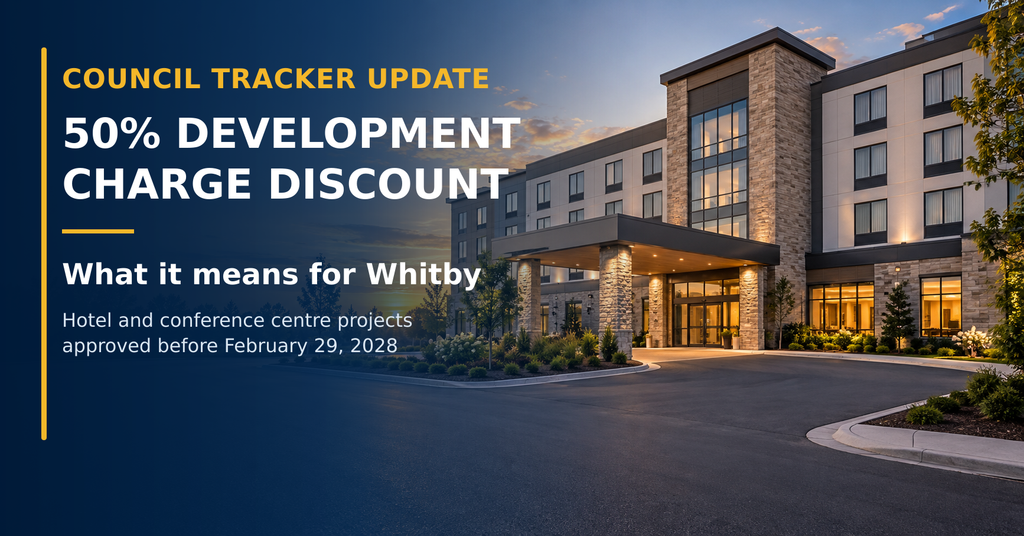
On August 26, Whitby Council approved a 50% discount on the Town’s portion of development charges for eligible hotel and conference centre projects.
The decision passed 8-1. Mayor Elizabeth Roy and Councillors Victoria Bozinovski, Matt Cardwell, Chris Leahy, Steve Lee, Rhonda Mulcahy, Maleeha Shahid, and Steve Yamada voted in favour. Councillor Niki Lundquist voted against.
So, what does this mean? And what questions should residents be asking?
What are development charges?
Development charges, often called DCs, are fees paid by developers to help cover the cost of growth.
They help pay for things a growing community needs, including roads, parks, recreation facilities, fire services, libraries, and storm water infrastructure.
They aren’t part of regular property-taxes. But if development-charges aren’t collected, the Town may need to find other ways to pay for growth-related infrastructure. That can mean using reserves, taking on debt, delaying projects, or putting more pressure on taxpayers.
What Council approved
Whitby already had a Hotel and Conference Centre Attraction Program.
Under the original program, qualifying applicants could delay payment of the Town’s development charges until occupancy. The program also included interest relief and deadlines meant to encourage projects to move ahead.
On August 26, Council went further. It approved a 50% discount on the Town’s development-charge portion for eligible hotel and conference centre projects that receive building permits by February 29, 2028.
The original motion proposed a 100% discount. Council reduced it down to 50%.
That matters. A 50% discount is more careful than eliminating the charge completely. But it is still a real cost that needs to be explained clearly.
Why did Council do it?
Whitby’s been trying to attract a hotel and conference centre for years.
A new hotel and conference centre could support local events, businesses, tourism, and visitors. Town staff projected that the three enrolled hotel projects could create about 175 to 270 permanent jobs and bring an estimated $8.4 million to $14 million a year in off-site visitor spending.
Those are projections, not guarantees. But they show why Council sees potential value in these projects.
The important context
Town staff did not recommend an additional development-charge discount.
The staff report said the existing attraction program was already working. Three applicants had enrolled, and the program already deferred development-charge payments until occupancy.
Staff also warned that development-charge revenues have dropped in recent years. That money helps fund the infrastructure needed when Whitby grows.
For the hotel projects, staff estimated that a full 100% Town development-charge discount could mean giving up about $2.0 million to $4.2 million per project, depending on its size. A 50% discount would mean giving up roughly half of the actual charge for an eligible project.
That doesn’t automatically make the decision wrong. It does mean residents deserve clear answers about the cost, the benefit, and how the Town will protect infrastructure funding.
My view
I’m not against attracting a hotel and conference centre to Whitby.
A good project could create jobs, support local businesses, and give Whitby more space for events, visitors, and conferences.
But incentives should be earned. They shouldn’t become a blank cheque.
I understand why Council chose a 50% discount instead of the original 100% proposal. It’s a more cautious approach. Still, before supporting a program like this, I’d want the Town to publicly show:
- The normal development charges for each approved project and the amount being discounted
- Why the discount was needed for the project to move ahead
- The construction and occupancy milestones each project must meet
- The expected and actual jobs, visitor spending, and community benefits
- Whether the reduced development-charge revenue puts pressure on reserves, debt, property taxes, or planned infrastructure
- What happens if a project doesn’t meet its commitments
Growth should pay for growth as much as possible. If Council offers an incentive, residents should be able to see the full deal and judge whether it delivers fair value.
How I’ll communicate with Ward 4
If I’m elected, I’ll keep sharing plain-English updates on important Council decisions like this one.
I’ll explain what was approved, how Council voted, what it could mean for residents, and the questions I believe deserve clear answers.
You shouldn’t have to search through long reports or watch hours of meetings to understand decisions that could affect Whitby’s future.
Read the official sources: