One of my top priorities is accountability and transparency.
Residents deserve to know not only where their tax dollars go, but whether Town Hall is getting good value for the money it spends. Independent oversight is an important part of that.
One of the first questions residents ask me about a two-year freeze on the Town’s portion of property taxes is fair: where will the savings come from?
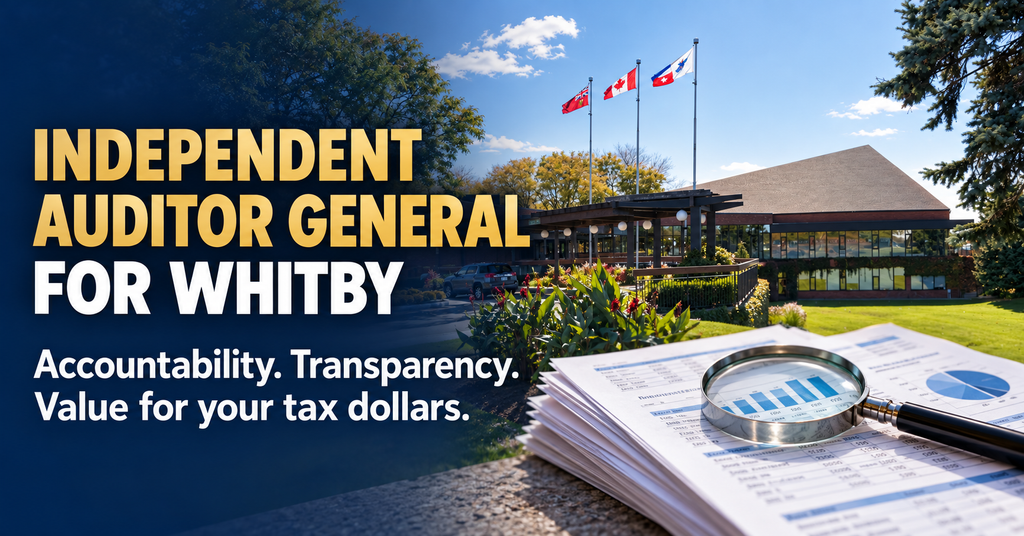
Savings need to be found openly, tested independently, and reported back to residents. That’s why I believe Whitby should establish an independent Auditor General.
A good one-time example
In February 2025, Mayor Roy directed the CAO to seek advice on retaining an objective third-party expert for a Core Services Review. The review is meant to look at what services the Town delivers, whether they are delivered at the right standard, procurement practices, the use of consultants, and ways to reduce costs.
The Town also says staff found more than $2 million in savings through line-by-line reviews during the 2026 budget process. The Core Services Review is now underway, with recommendations expected for the next Council.
Those are worthwhile, best practice approaches that find real savings. I support looking carefully for efficiencies before releasing a proposed budget asking residents for more money.
But a Core Services Review is a one-time project. Staff-led budget reviews happen inside the organization. Once the review is complete, the project ends.
An independent Auditor General would make line-by-line value-for-money oversight reviews part of the best practice approach for Whitby’s annual proposed budget process.
What an Auditor General does
An Auditor General isn’t the same as the outside accounting firm that audits the Town’s yearly financial statements.
Under Ontario’s Municipal Act, a municipal Auditor General reports directly to Council and must do the work independently. The role is to help Council hold itself and Town administration accountable for the stewardship of public funds and value for money.
Depending on the mandate Council gives the office, an Auditor General can examine areas such as:
- Procurement and major contracts
- Consulting costs and service delivery
- Capital projects and cost overruns
- Technology, software, and cybersecurity spending
- Grants, fees, and other revenue collection
- Whether savings promised by past reviews were actually achieved
- Controls that prevent fraud, waste, and misuse of public money
The role isn’t about blaming staff or cutting services for the sake of a headline. It’s about asking practical questions: Is the Town getting what it paid for? Is there a better way to deliver the service? Are residents seeing the results that were promised?
The key difference: independence and follow-through
The most important part of the role is independence.
An Auditor General should have a public work plan, report directly to Council, and publish findings so residents can see both the recommendations and the progress made on them. The office should also report back on whether savings were actually realized, not just estimated.
That creates follow-through. A report sitting on a shelf doesn’t save a dollar.
Whitby Council voted down a chance to move forward
In November 2025, Councillor Chris Leahy brought a motion to Whitby Council to put a question on the 2026 municipal-election ballot. It would have asked voters whether the Town should create an independent Office of the Auditor General to identify potential savings and improve oversight of spending and procurement.
It wasn’t a motion to create the office immediately. It was a motion to ask Whitby residents directly whether they supported creating one.
The motion was defeated on a recorded 3-6 vote. Councillors Leahy, Victoria Bozinovski, and Steve Yamada voted in favour. Mayor Elizabeth Roy voted against it, along with Councillors Steve Lee, Rhonda Mulcahy, Maleeha Shahid, Matt Cardwell, and Niki Lundquist.
If I’m elected, I’ll support a practical motion to establish an independent Auditor General for Whitby. It should include a clear mandate, a public cost, and regular reporting on results.
Durham Region is moving in this direction
Durham Region recently voted in favour to bringing in an independent Auditor General and Regional Council has directed staff to move toward creating one.
Councillor Chris Leahy first brought forward a 2025 motion, seconded by Councillor Steve Yamada, asking for a report on establishing an independent Auditor General. After the Region reviewed its options, Leahy and Yamada brought forward a February 2026 amendment directing the Region to proceed toward establishing an independent Office of the Auditor General.
Staff are now developing the terms of reference, authority, audit scope, staffing, and budget required for Regional Council to consider the office during the 2027 budget process.
That matters because many of the biggest services Whitby residents pay for, including water, wastewater, transit, paramedics, regional roads, and social services, are delivered by Durham Region. Strong oversight at the Region would benefit Whitby residents too.
What Toronto’s experience shows
Toronto’s Auditor General’s Office shows why independent oversight can be worth the investment.
Toronto’s 2024 Auditor General report said that recommendations from its 2020 to 2024 annual reports produced more than $376 million in cumulative one-time and recurring savings projected over five years. The City said the Auditor General’s Office provided an $11 return for every $1 invested.
Those figures include savings that City management implemented after audit recommendations, as well as revenue increases and avoided future costs.
Toronto’s office also operates a Fraud and Waste Hotline. In 2024, it received 679 complaints involving about 1,050 allegations. The office reported $2 million in actual losses and $1.1 million in potential losses from 2020 to 2024 that were identified or prevented through hotline work.
The lesson is that an independent office with a clear mandate, public reporting, and follow-up can protect taxpayer dollars and improve how government works.
Other Ontario municipalities are using similar models. Ottawa has an Auditor General that performs value-for-money, financial, and compliance audits. Peel Region established an independent Auditor General’s Office in 2025, with authority to audit departments, local boards, grant recipients, and Peel Living, as well as operate a confidential fraud and waste hotline.
What I would propose for Whitby
If I’m elected, I’ll ask Council to request a public report on the best independent Auditor General model for Whitby. That report should compare options, including a full office, a shared service with another municipality, or a contracted value-for-money audit model that can grow over time.
It should include the cost of each option and how success will be measured. No blank cheque.
I would push for a model that includes:
- A role that reports directly to Council, not the CAO or Mayor
- A public, risk-based annual audit plan
- Regular public reports on findings, recommendations, and savings actually achieved
- Clear authority to review procurement, consulting, capital projects, service delivery, and major spending risks
- A confidential fraud and waste reporting channel with proper safeguards
- A public follow-up report so recommendations don’t disappear after the headlines
The Town’s budget process should also make use of this work. An Auditor General shouldn’t be asked to approve every line of a proposed budget. Council still has to make the budget choices, and residents still need a chance to provide input.
But selected high-cost or high-risk areas can be audited early enough for the findings to inform the draft budget and the public discussion. That is a more responsible way to look for savings before tax increases are proposed.
My commitment
An independent Auditor General won’t solve every budget pressure. It won’t replace good management, a careful Council, or honest public debate.
But it can give residents something they deserve: an independent set of eyes focused on whether their money is being spent wisely, whether promised savings are real, and whether Whitby is getting good value.
That’s how we move from simply explaining why taxes have to go up to doing the hard work of finding savings first.
Sources
- Ontario Municipal Act, 2001, section 223.19
- Mayor Roy’s February 2025 Core Services Review directive
- Town update on the 2026 budget and Core Services Review
- Whitby Council record: November 24, 2025 referendum question on an Auditor General
- Durham Regional Council highlights, February 25, 2026
- Chris Leahy and Steve Yamada’s 2025 motion seeking a Durham Auditor General report
- Toronto Auditor General’s 2024 annual report
- Toronto’s 2024 Fraud and Waste Hotline report
- Peel Region’s 2025 Auditor General announcement
- Ottawa Auditor General mandate